The Mission
I came to California with a mission: I was going to find Pluto and Granddaddy Purp (GDP). Now, coming up on two years here, I’ve managed to find them both in flower form and as S1 seeds.
I’ve already run the Pluto S1s twice with less-than-stellar results. While this current run has shown a lot of improvement in veg, the flowers aren’t quite checking out visually so far. It might be the cultivator, or it might just be this particular phenotype—that remains to be determined.
But Granddaddy Purp was always the main objective. I wanted it in flower form to relive past glories. Fortunately, around Halloween last year, Connected did a limited retail drop of GDP. That release satisfied my craving for a minute, but I’m still looking for something more consistent—readily available, and possessing the exact qualities I desire most from the strain.
When I’m hunting for true GDP, I’m looking for three specific things:
- The Effects: First and foremost, it needs to slump me. I need it to make me heavy, drowsy, and sleepy.
- The Terps: Second, the grape taste needs to be overwhelming.
- The Bag Appeal: Third, it needs to be purple. Ideally, that deep, almost-black kind of purple.
I distinctly remember those traits from back in the day. It wasn’t a strain that came around all the time, but when it did, the experience was identical every single run. Now that I understand more about how it actually grows, I don’t have high hopes of finding it readily available and high quality on commercial shelves. I’ve seen “GDP” on menus for years, but it was green, so I stayed away. Connected’s drop was purple, and so was some I recently found out in Jamaica. Both were pretty true to the legacy, but Jamaica was actually closer to what I remember.
To solve the availability problem, I’m taking matters into my own hands and growing out CSI Humboldt’s GDP S1. I started a few of these once before but ended up scrapping that run. This new girl germinated around May 10th, making her about 8 days old today. She is tiny right now compared to the others started alongside her, but in my research, I’ve stumbled upon plenty of stories about how small she can be in the beginning, so I’m not surprised.
We will see, we will see! At the end of the day, if the phenotype I select turns out absolutely fire and reminiscent of what I am seeking, I won’t even be upset if she stays green.
Looking Ahead: The Game Plan
To give this CSI Humboldt gear the best chance to shine, I’m changing things up for the next phase of the garden. Instead of just letting things ride, I’m dialing in a specific strategy for this run. My blueprint for a successful harvest comes down to three things: dialing in my environment, returning to a single high-powered light, and tracking my actions rigorously.
1. Environmental Automation & VPD
My environment has been heavily neglected in previous runs because I’d historically gotten decent results without caring too much about it. On my current run, I tried to get more focused, but I slacked majorly on humidity management. It was the first time I ran zero dehumidifiers or humidifiers, which definitely stunted the plants. The yield is looking less than stellar, and it stood out to me that swinging humidity was causing my VPD to be completely out of whack.
To fix this, I’ve already got a dehumidifier ready and purchased a new humidifier to replace my old one (which has somehow gone missing). I’m plugging the new humidifier directly into my AC Infinity controller so I can automatically raise the humidity, which is desperately needed this season. Eventually, I’ll add the AC Infinity dehumidifier to the controller for total automated ecosystem control, but for now, my two standard dehumidifiers will do the trick.
2. Retiring the 4x2s for the Mars Hydro FC4800
I’m also going back to my Mars Hydro FC4800 for flowering. A while back, I made the decision to try for a perpetual harvest using two 4×2 tents with lights pushing between 250 and 300 watts. I ended up blowing that strategy because I chased numbers over quality. By going for numbers, I suffered a tremendous drop in yield potential and wound up with less-than-stellar buds. After two runs, I am officially retiring that setup.
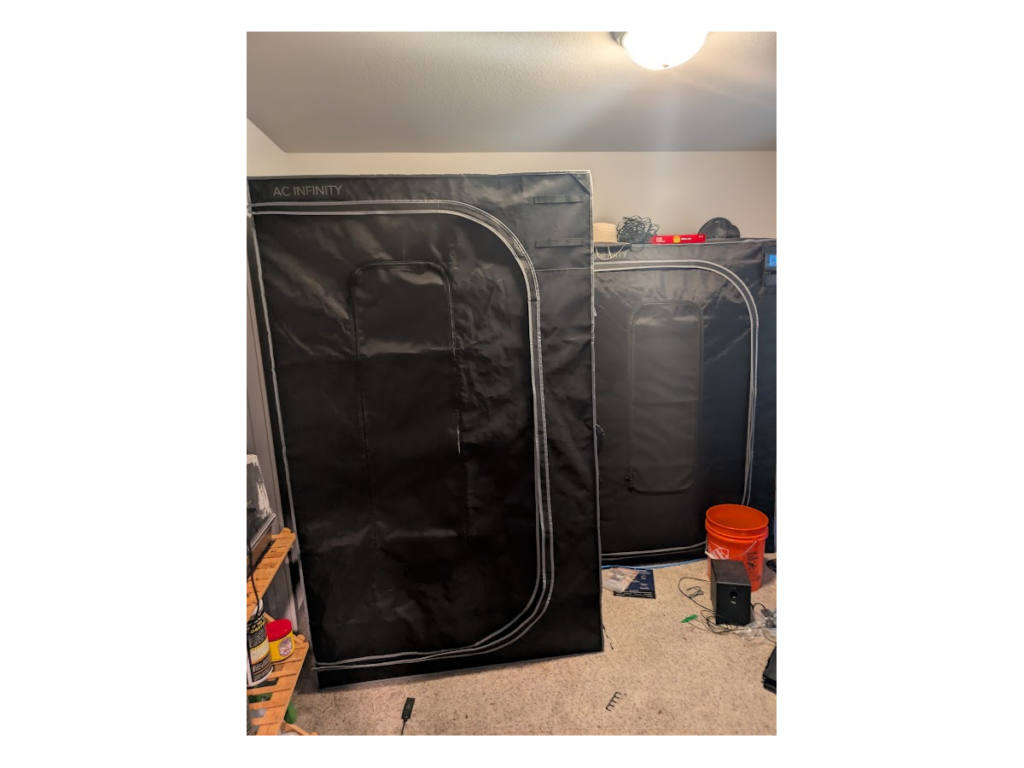
I’m replacing one of the 4×2 tents with a 4×4 so I can unleash the FC4800 again. During my first run in California, I used the FC4800 in a 3×3 and got crazy results, but I spent a good portion of flower fighting powdery mildew because it was my first time running into local humidity issues. I’ve done a ton of research since then and haven’t seen a sniff of PM since. Moving to a 4×4 gives the FC4800 enough clearance away from the tent walls, whereas last time the edges were touching the canvas and creating too much trapped heat.
When I was running a hunt through some seeds I crossed earlier this year, I had them under the open frame of the FC4800 and they absolutely thrived, growing like absolute champions. The second I moved them under those lesser-powered lights in the 4x2s, the vigor vanished. Plants took weeks to achieve the kind of growth that was happening in days under the FC4800.
3. Rigorous Event Logging
The final piece of the strategy is data collection. I’ve been battling random deficiencies over the past three runs—something I rarely encountered when I first started growing back in Georgia. After a hard look in the mirror, I realized that as I advanced as a grower, I started skipping steps, doing things out of order, or throwing too much or too little of something into the mix.
All of those variables can be easily mitigated if I keep a strict log of everything I do. When something goes sideways, a solid data log makes it a hell of a lot quicker to identify exactly what went wrong.
I’m going to take some time to map out the most critical metrics and events I need to track. When I have that system built, I will come back here and break it down with you.
Until next time, peace!